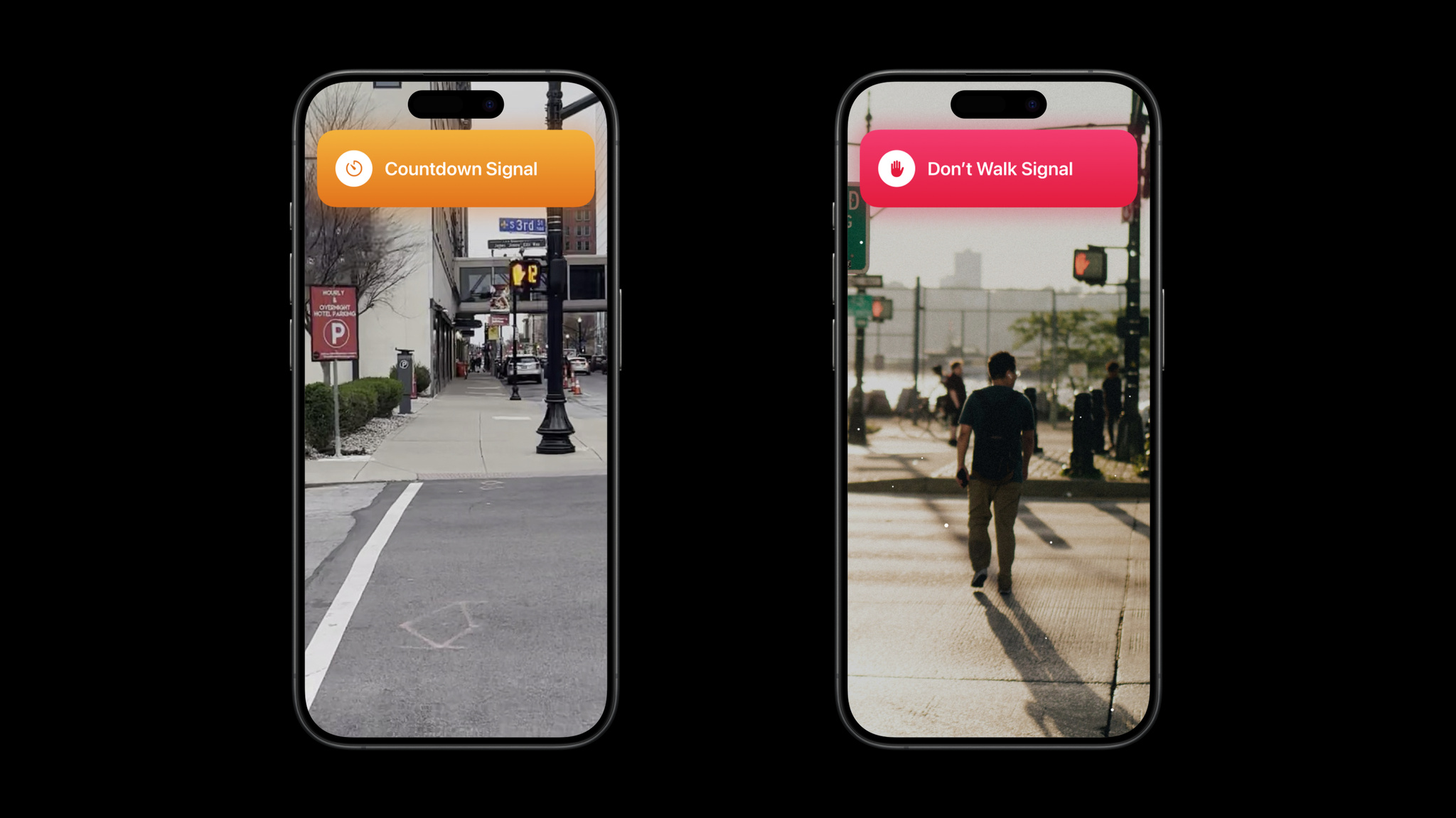
Oko is a testament to the power of simplicity.
The 2024 Apple Design Award winner for Inclusivity and 2024 App Store Award winner for Cultural Impact leverages Artificial Intelligence to help blind or low-vision people navigate pedestrian walkways by alerting them to the state of signals — “Walk,” “Don’t Walk,” and the like — through haptic, audio, and visual feedback. The app instantly affords more confidence to its users. Its bare-bones UI masks a powerful blend of visual and AI tools under the hood. And it’s an especially impressive achievement for a team that had no iOS or Swift development experience before launch.
“The biggest feedback we get is, ‘It’s so simple, there’s nothing complex about it,’ and that’s great to hear,” says Vincent Janssen, one of Oko’s three Belgium-based founders. “But we designed it that way because that’s what we knew how to do. It just happened to also be the right thing.”
ADA FACT SHEET

From left: Willem Van de Mierop, Michiel Janssen, and Vincent Janssen are the three cofounders of Oko. The app’s name means “eye.”
Oko
- Winner: Inclusivity
- Team: AYES BV
- Available on: iPhone
- Team size: 6
- Previous accolades: 2024 App Store Award winner for Cultural Impact; App Store Editors’ Choice
Download Oko from the App Store
For Janssen and his cofounders, brother Michiel and longtime friend Willem Van de Mierop, Oko — the name translates to “eye” — was a passion project that came about during the pandemic. All three studied computer science with a concentration in AI, and had spent years working in their hometown of Antwerp. But by the beginning of 2021, the trio felt restless. “We all had full-time jobs,” says Janssen, “but the weekends were pretty boring.” Yet they knew their experience couldn’t compare to that of a longtime friend with low vision, who Janssen noticed was feeling more affected as the autumn and winter months went on.
“We really started to notice that he was feeling isolated more than others,” says Janssen. “Here in Belgium, we were allowed to go for walks, but you had to be alone or with your household. That meant he couldn’t go with a volunteer or guide. As AI engineers, that got us thinking, ‘Well, there are all these stories about autonomous vehicles. Could we come up with a similar system of images or videos that would help people find their way around public spaces?’”
I had maybe opened Xcode three times a few years before, but otherwise none of us had any iOS or Swift experience.
Vincent Janssen, Oko founder
The trio began building a prototype that consisted of a microcomputer, 3D-printed materials, and a small portable speaker borrowed from the Janssen brothers’ father. Today, Janssen calls it “hacky hardware,” something akin to a small computer with a camera. But it allowed the team and their friend — now their primary tester — to walk the idea around and poke at the technology’s potential. Could AI recognize the state of a pedestrian signal? How far away could it detect a Don’t Walk sign? How would it perform in rain or wind or snow? There was just one way to know. “We went out for long walks,” says Janssen.
And while the AI and hardware performed well in their road tests, issues arose around the hardware’s size and usability, and the team begin to realize that software offered a better solution. The fact that none of the three had the slightest experience building iOS apps was simply a hurdle to clear. “I had maybe opened Xcode three times a few years before,” says Janssen, “but otherwise none of us had any iOS or Swift experience.”